

Ground reference maneuvers teach the most useful skill in low-altitude flying: correcting for wind so the airplane follows a precise path over the ground. In the rectangular course, S-turns and turns around a point, the rule is the same: the higher your groundspeed, the steeper your bank, so the bank is steepest heading downwind and shallowest heading into the wind. They are flown at 600 to 1,000 feet AGL, and on the Private Pilot checkride the examiner picks at least one and expects altitude within 100 feet and airspeed within 10 knots.
Part of our Flight Maneuvers guide. This page is educational and is not a substitute for instruction from a certificated flight instructor.
The purpose: wind correction and ground track
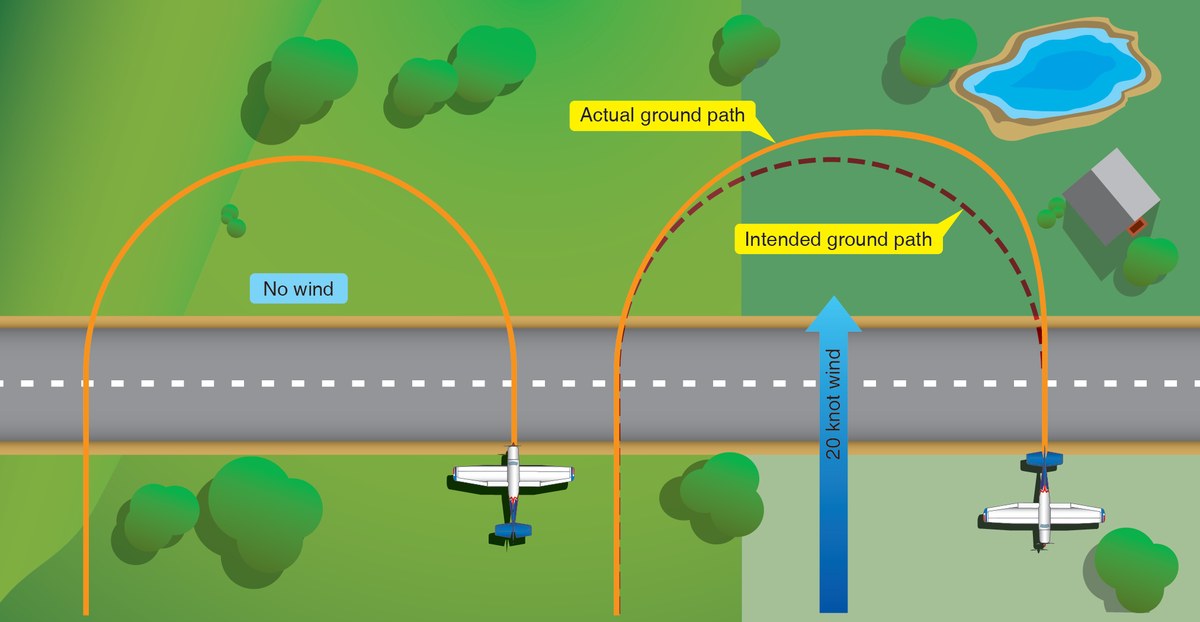
An airplane flies through a moving mass of air, so the wind constantly pushes it off the path you intend over the ground. To hold a constant ground track you crab into the wind, turning the nose upwind by the right amount and changing that amount as your direction relative to the wind changes. In a turn, this means continuously varying your bank angle: steepest when the airplane is moving with a tailwind and groundspeed is highest, shallowest when it is moving into the wind and groundspeed is lowest. Learning to feel and apply this correction is the whole point of the maneuvers, and it is exactly what you use flying the traffic pattern and a crosswind approach.
They are required training: 14 CFR 61.87(d)(12) lists ground reference maneuvers among the maneuvers you must be trained in before solo, and they are an area of operation for the private pilot certificate under 61.107(b)(1).
The ACS standard: Task V.B
Ground Reference Maneuvers is Task B of Area of Operation V in the Private Pilot for Airplane Category ACS (FAA-S-ACS-6C). The task may include a rectangular course, S-turns and turns around a point, and the evaluator selects at least one for you to demonstrate. The skill elements are:
- Clear the area and select a suitable ground reference area, line or point.
- Plan the maneuver at 600 to 1,000 feet AGL. For the rectangular course, enter a left or right pattern 45° to the downwind leg; for S-turns, enter perpendicular to the reference line; for turns around a point, enter at an appropriate distance from the point.
- Apply adequate wind drift correction in straight and turning flight to hold a constant ground track around a rectangular area, or a constant radius on each side of a line or around a point.
- For S-turns, reverse the turn directly over the reference line; for turns around a point, complete turns in either direction, as the evaluator specifies.
- Divide your attention between airplane control, traffic avoidance and the ground track while maintaining coordinated flight.
- Maintain altitude ±100 feet and airspeed ±10 knots.
Knowledge elements include the effect of wind on ground track, how bank angle and groundspeed affect rate and radius of turn, and how the rectangular course relates to the traffic pattern. See our Private Pilot ACS guide for how the elements work.
- 600 to 1,000 ft AGL; hold altitude ±100 ft, airspeed ±10 kt
- Bank steepest downwind, shallowest upwind; 45° maximum
- Airspeed no faster than maneuvering speed
- Rectangular course: enter 45° to the downwind leg
- S-turns: enter downwind, perpendicular to the line; wings level over it
- Turns around a point: enter downwind; turn the direction assigned
- Clear the area; keep an emergency landing field in mind
Altitude, area selection and safety
These maneuvers are flown low enough that wind drift is obvious against ground features, but high enough to stay safe. The ACS range of 600 to 1,000 feet AGL matches the FAA Airplane Flying Handbook (FAA-H-8083-3C), which adds what to weigh when you choose a spot:
- Drift should be easy to see from both sides of the airplane; the lower you fly, the faster the ground appears to move.
- Allow obstruction clearance of at least 500 feet vertically and 2,000 feet horizontally.
- Stay well away from congested areas, open-air assemblies of people and livestock. Under 14 CFR 91.119, flight over a congested area or an open-air assembly requires 1,000 feet above the highest obstacle within 2,000 feet, so these maneuvers belong over open country, where the minimum is 500 feet above the surface, or 500 feet from any person, vessel, vehicle or structure over sparsely populated areas.
- Lower altitude leaves less time and glide distance if the engine quits, so always have a field picked out.
- Clear the area with two 90° clearing turns, looking left, right, above and below, and make any practice-area radio calls.
The AFH says a ground reference maneuver should not exceed 45° of bank or an airspeed greater than maneuvering speed, and you should know your POH stall speed at the steepest bank you expect. Stall speed climbs with bank, which is why stall awareness matters this close to the ground. If the bank you need gets too steep, exit and re-enter farther from the reference.
Wind correction: the logic behind every maneuver
Two things change as your direction relative to the wind changes: drift and groundspeed.
- Drift and crab. A crosswind pushes you sideways, so you angle the nose into the wind just enough to cancel it. The AFH example: at 100 knots, a 20-knot direct crosswind needs about 12° of correction, and a 10-knot crosswind about 6°. You do not calculate it in flight; you watch your references (our wind correction angle guide shows the math).
- Groundspeed and bank. A constant bank gives a constant radius only through the air. Over the ground, the circle stretches where groundspeed is high and tightens where it is low, so you vary the bank to keep the ground radius constant: steeper where groundspeed is higher, shallower where it is lower.
The AFH puts numbers on it. At 90 knots airspeed in a 10-knot wind, a turn started downwind (100 knots groundspeed) with 45° of bank has a radius over the ground of about 890 feet; holding that same radius heading upwind (80 knots groundspeed) takes only about 33°. For a wider 2,000-foot radius, the bank runs about 24° downwind and 16° upwind.
Rectangular course
The rectangular course replicates the airport traffic pattern: you fly parallel to the four sides of a field at a constant distance, altitude and airspeed, on legs named downwind, base, upwind and crosswind.
- Pick the field. A square or rectangular field, or an area with good references on all four sides. Fly one-half to three-quarters of a mile outside the boundaries, where you can see them from either seat; flying closer forces very steep banks in the turns.
- Enter 45° to the downwind leg at your chosen altitude, as you would a traffic pattern.
- Downwind leg: tailwind, highest groundspeed, little or no crab.
- Downwind to base: the steepest bank of the course, rolled in promptly and shallowed as groundspeed falls. Turn more than 90°, so you are crabbed toward the field against the drift.
- Base to upwind: a medium bank, and less than 90° of turn, because you were already angled into the wind.
- Upwind to crosswind: the shallowest bank, rolled in slowly while the wind drifts you toward the field. Turn less than 90° and hold a crab away from the field.
- Crosswind to downwind: a medium bank held as groundspeed builds, more than 90° of turn, and a prompt rollout.
Match the roll rate to the drift: roll in slowly when the wind is drifting you toward the inside of the course and quickly when it is drifting you outside.
S-turns across a road
S-turns are a series of equal half circles on alternating sides of a straight reference line, such as a road or railroad track, crossing the line with wings level each time. Choose a line perpendicular to the wind.
- Enter downwind, crossing the line at 90°, and start the first turn as you cross it, with the steepest bank, because groundspeed is highest.
- Shallow the bank through the first half circle. As you turn crosswind and then upwind, groundspeed falls, so reduce the bank progressively. At the crosswind point you need your full wind correction angle: in the AFH example with a 10° correction, the first 90° over the ground takes 100° of heading change and the second 90° only 80°.
- Cross the line wings level, heading upwind, and roll immediately into the opposite turn. The ACS requires the reversal directly over the reference line.
- Steepen the bank through the second half circle. It starts shallow and gentle because you are slow over the ground, then steepens as you turn crosswind and downwind, reaching its steepest just before you roll out over the line.
Turns around a point
Turns around a point extend the same idea to a full circle: a constant-radius 360° turn around a single prominent reference that is easy to see but small enough to be precise, with open fields around it for an emergency landing.
- Enter downwind at the radius you want. Groundspeed is highest here, so the first bank is the steepest of the circle; in a strong wind, roll it in briskly so you do not drift outside the radius.
- Shallow the bank as you turn through crosswind to upwind, reaching the shallowest bank heading directly into the wind.
- Steepen it again through crosswind to downwind, reaching the steepest bank back at the entry point.
- Manage the crab. On the downwind half of the circle the wind pushes you outward, so the nose is angled toward the inside of the turn, ahead of your position over the ground; on the upwind half the wind pushes you inward, so the nose is angled toward the outside, behind your position.
Expect to turn in either direction, as the evaluator specifies; the AFH calls for at least one full turn and suggests two or more to assess the wind. In a high-wing airplane the lowered wing can hide the point, especially in left turns from the left seat; change your altitude or radius so the point stays in view.
Do not fixate on the reference. The AFH warns that staring at one spot destroys your sense of rate; scan across several references so you see drift early and still spot traffic.
Common errors
The AFH lists nearly the same errors for all three maneuvers:
- Not clearing the area for traffic and other hazards, at the start and throughout.
- Not establishing a constant, level altitude before entering, then failing to hold it.
- Misjudging the wind direction.
- Failing to establish the right wind correction angle or to fly constant-radius turns.
- Rough, uncoordinated control inputs that produce slips and skids.
- Poor division of attention between flying the airplane and watching the references, and turns that are poorly timed.
Watch coordination most of all: a skid at low altitude, such as tightening a turn with rudder, is a classic stall-spin setup, so keep the ball centered.
Putting it together
Every ground reference maneuver is really one lesson taught three ways: the airplane moves with the air, so you correct for the wind to control where it goes over the ground. The load factor side of the story continues in steep turns, and at the commercial level the same skills return in eights on pylons. Fly them coordinated, keep your altitude, and keep a sharp lookout. They are a standard part of preparing for the checkride.
Study tools
What you'll need
The FAA handbooks and the ACS that teach and test the maneuvers, all from PilotMall.com.


Frequently asked questions
What is the purpose of ground reference maneuvers?
They teach you to correct for wind so the airplane holds a constant, precise track over the ground. You crab into the wind and vary your bank to counter drift, which is the same skill you use in the traffic pattern and on a crosswind approach.
What altitude are ground reference maneuvers flown at?
The Private Pilot ACS and the FAA Airplane Flying Handbook both use 600 to 1,000 feet AGL, low enough that wind drift is obvious against ground features but high enough to stay safe, clear of obstructions and away from congested areas.
Why do you vary the bank angle in turns around a point?
Because groundspeed changes as you turn relative to the wind. You steepen the bank where groundspeed is highest, heading downwind, and shallow it where groundspeed is lowest, heading into the wind, to trace a constant-radius circle.
What are the three main ground reference maneuvers?
Turns around a point, S-turns across a road, and the rectangular course. All three train wind correction to hold a constant ground track, and the rectangular course is essentially flying a traffic pattern.
What are the ACS standards for ground reference maneuvers?
Under Private Pilot ACS Task V.B the evaluator picks at least one maneuver, flown at 600 to 1,000 feet AGL. You must hold altitude within 100 feet and airspeed within 10 knots while applying wind drift correction, staying coordinated and dividing your attention between the airplane, traffic and the ground track.
Where is the bank steepest in S-turns?
Wherever you are heading downwind with the highest groundspeed: right after crossing the road on the downwind side, and just before crossing back from the upwind side. The bank is shallowest as you approach and leave the road heading upwind, with the wings level directly over the road.