

To act as pilot in command of a high-performance airplane (one with an engine of more than 200 horsepower) or a complex airplane (retractable landing gear, flaps and a controllable-pitch propeller), you need logged ground and flight training from an authorized instructor and a one-time logbook endorsement under 14 CFR 61.31(f) or 61.31(e). There is no minimum number of hours and no FAA test: your instructor signs you off when you are proficient in the airplane’s operation and systems. Some airplanes, such as the Beechcraft A36 Bonanza, require both endorsements.
Part of our Pilot Endorsements guide. If you have never used a propeller control, read how a constant-speed propeller works before your first lesson.
What makes an airplane complex
14 CFR 61.1 defines a complex airplane as one that has all three of these:
- Retractable landing gear
- Flaps
- A controllable-pitch propeller, or an engine control system that uses a digital computer to control the engine and propeller, such as a full authority digital engine control (FADEC)
A constant-speed propeller counts, because the FAA describes it as a controllable-pitch propeller whose pitch a governor varies automatically. For a seaplane the gear drops out of the definition: flaps plus a controllable-pitch propeller (or FADEC) make it complex. A landplane missing any one item is not complex. A fixed-gear airplane with a constant-speed propeller does not need the complex endorsement, although it may need the high-performance one.
What makes an airplane high-performance
Section 61.31(f) defines a high-performance airplane as “an airplane with an engine of more than 200 horsepower.” Gear, flaps and propeller type play no part. The FAA’s Airplane Flying Handbook (AFH) puts it as an engine capable of developing more than 200 horsepower, so an engine rated at exactly 200 does not qualify. Engines can be changed by modification, so confirm the rating for the specific airplane in its flight manual and records.
Which endorsement do common airplanes need?
The engine ratings below come from the FAA type certificate data sheets (TCDS) for each model. All four airplanes have flaps and constant-speed propellers.
| Airplane | Landing gear | Engine rating (FAA TCDS) | Complex | High-performance |
|---|---|---|---|---|
| Piper PA-28R Arrow series | Retractable | 200 hp (180 hp on the original PA-28R-180) | Yes | No |
| Cessna 182 Skylane, fixed-gear models | Fixed | 230 or 235 hp | No | Yes |
| Cessna R182 Skylane RG | Retractable | 235 hp | Yes | Yes |
| Beechcraft A36 Bonanza | Retractable | 285 or 300 hp | Yes | Yes |
The Arrow sits right on the line. Most versions are rated at exactly 200 horsepower, not more than 200, so the Arrow needs only the complex endorsement. The fixed-gear Cessna 182 is the opposite case: high-performance but not complex. A tailwheel airplane also needs a tailwheel endorsement. Always check the exact model and serial number you will fly.
What 61.31(e) and (f) require
The two paragraphs are written the same way. For either endorsement you must:
- Receive and log ground and flight training from an authorized instructor in a complex (or high-performance) airplane, or in a full flight simulator or flight training device that is representative of one.
- Be found proficient in the operation and systems of the airplane.
- Receive a one-time endorsement in your logbook from an authorized instructor who certifies that you are proficient to operate a complex (or high-performance) airplane.
The AC 61-65K sample endorsement for complex (A.72) certifies that you received the training required by 14 CFR 61.31(e) in a named make and model of complex airplane and that the instructor has determined you are proficient in the operation and systems of a complex airplane. The high-performance sample (A.73) is identical apart from the paragraph and the type of airplane. Because the rule calls it a one-time endorsement for complex airplanes in general, you do not need a new one for each complex model. Your systems knowledge is model-specific, though, so plan on a checkout in every new airplane.
Who is exempt
- Pilots who logged PIC time in a complex airplane (for the complex endorsement) or a high-performance airplane (for the high-performance endorsement), or in a representative simulator or flight training device, before August 4, 1997.
- Pilots who received ground and flight training under an approved training program and completed a 14 CFR 135.293 competency check in that kind of airplane or a representative device, documented in their logbook or training record.
Total flight time alone does not exempt anyone: without one of these credits, even a very experienced pilot needs the training and endorsement.
Sport pilots under the 2025 rules
Under the FAA’s 2025 sport pilot rule changes, a sport pilot may fly an aircraft with retractable landing gear or an airplane with a manual controllable-pitch propeller after the training and endorsement in 14 CFR 61.331. That section accepts either the 61.31(e) complex training and endorsement or training and an endorsement specific to the retractable gear or the propeller (AC 61-65K samples A.27 and A.28). Sport pilots need no such endorsement for a fixed, ground-adjustable or automated controllable-pitch propeller (61.316(a)(9)).
What the training covers
AFH Chapter 12, Transition to Complex Airplanes, says the transition should follow a structured course built on a ground and flight training syllabus, aimed at the Airman Certification Standards for the certificate you hold or are working toward. Its sample syllabus uses three one-hour ground lessons and three one-hour flights, and it labels those times as illustrations to be adjusted to the pilot:
| Ground (AFH sample) | Flight (AFH sample) |
|---|---|
| Operations sections of the flight manual, line inspection, flight deck familiarization | Flight training maneuvers; takeoffs, landings and go-arounds |
| Loading, limitations and servicing; instruments, radio and special equipment; aircraft systems | Emergency operations; control by reference to instruments; use of radio and autopilot |
| Performance section of the flight manual, cruise control, review | Short- and soft-field takeoffs and landings; maximum performance operations |
Power management with a constant-speed propeller
You will set power with two levers: the throttle sets manifold pressure and the propeller control sets RPM. The AFH sequence is to increase RPM before manifold pressure when adding power and to reduce manifold pressure before RPM when reducing it, using the settings in the cruise power charts of the POH. Our constant-speed propeller guide explains why.
Flaps
Flap behavior depends on the design, so learn your airplane’s. The AFH recommends extending flaps in increments around the pattern to support a stabilized approach, and it says never to exceed the POH flap setting for takeoff. Our flaps guide covers how they work.
Retractable landing gear
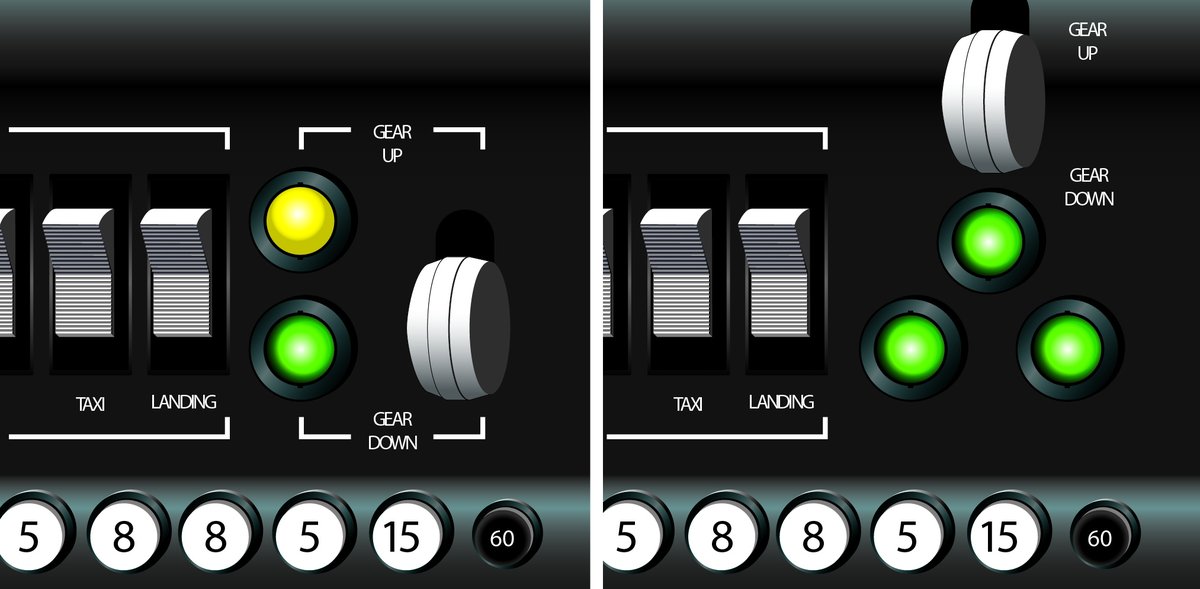
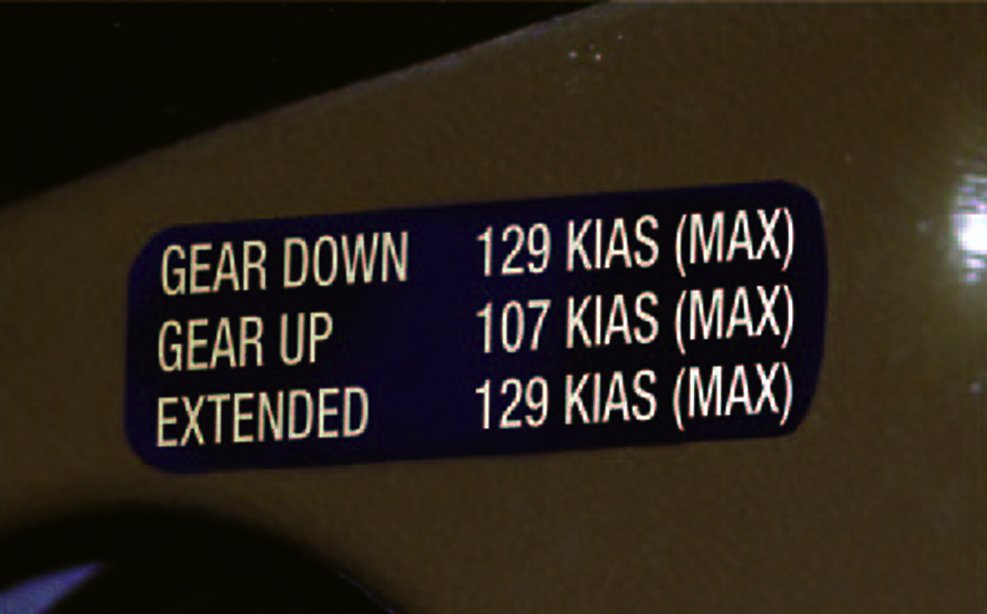
This is the biggest habit change. The AFH lists the frequent pilot errors with retractable gear, made both by pilots new to complex airplanes and by experienced pilots grown complacent: neglecting to extend the gear, retracting it inadvertently, selecting it without checking its position, misusing the emergency system, retracting it too early on takeoff and extending it too late. Training covers the gear system, its warning horn and lights, the emergency extension procedure, and two speeds from the POH:
- VLO, the maximum landing gear operating speed, the fastest you may extend or retract the gear.
- VLE, the maximum landing gear extended speed, the fastest you may fly with the gear down.
- Preflight: gear selector DOWN before the master switch goes on, then confirm down-and-locked indications.
- Takeoff: retract only after a positive rate of climb shows; plan the timing around runway left, obstacles and terrain.
- Downwind: gear down at the same point every time, no later than abeam the landing point, then the before-landing checklist.
- Final: recheck the gear-down indications.
- Rollout: touch no levers or switches until clear of the runway.
- Know: the emergency extension procedure, the warning horn and the lights for your airplane.
Turbocharging, if installed
If the airplane is turbocharged, the training adds slow, smooth power changes to avoid overboosting, the airplane’s critical altitude, and careful management of turbine inlet or exhaust gas temperature and cylinder head temperature. The AFH stresses following the manufacturer’s procedures for any turbocharger malfunction.
What you'll need
The FAA handbook behind your transition training, the regulations, a logbook for the endorsement, and an oral exam guide for the commercial checkride.


How it fits your commercial certificate
Commercial applicants for an airplane single-engine rating must log 10 hours of training in a complex airplane, a turbine-powered airplane or a technically advanced airplane (TAA), or any combination, under 14 CFR 61.129(a)(3)(ii). Section 61.129(j) defines a TAA by its avionics: an electronic primary flight display, a multifunction display with a GPS moving map showing the airplane’s position, and a two-axis autopilot integrated with the navigation and heading guidance, with both displays continuously visible. If you train in a complex airplane, the same lessons can earn your complex endorsement. See our commercial pilot requirements for the rest of the experience list.
Logging PIC time during the training
You do not need the endorsement to log PIC time on the training flights. Under 14 CFR 61.51(e)(1)(i), a private or commercial pilot logs PIC time while the sole manipulator of the controls of an aircraft for which the pilot is rated. The FAA’s Office of the Chief Counsel has explained that “rated” means category, class and type ratings, and that the complex and high-performance endorsements are not needed to log PIC time (Herman interpretation, May 21, 2009). Until you hold the endorsement, though, someone else, normally your instructor, must act as pilot in command. Our logbook guide covers how to record each flight.
Frequently asked questions
Do I need both endorsements to fly a Bonanza?
Yes. The Beechcraft A36 Bonanza has retractable gear, flaps and a constant-speed propeller, and its FAA type certificate data sheet lists engines rated at 285 or 300 horsepower, so you need both the complex endorsement (61.31(e)) and the high-performance endorsement (61.31(f)). Both can be earned during the same training in that airplane.
Is a Piper Arrow a high-performance airplane?
No. The Arrow’s engine is rated at 200 horsepower (180 on the original PA-28R-180) in FAA type certificate data sheet 2A13, and the rule requires more than 200. Because it has retractable gear, flaps and a constant-speed propeller, it is a complex airplane, so you need the complex endorsement only.
Is the Cessna 182 a complex airplane?
Not the standard fixed-gear Cessna 182. It has flaps and a constant-speed propeller but no retractable gear. Its 230 or 235 horsepower engine makes it high-performance, so you need the high-performance endorsement. The retractable-gear R182 Skylane RG needs both.
How many hours does a complex or high-performance endorsement take?
The regulation sets no minimum. You need logged ground and flight training and an instructor who finds you proficient in the airplane’s operation and systems. The Airplane Flying Handbook’s sample syllabus shows three hours of ground and three hours of flight training as an illustration; your actual time depends on your experience and the airplane.
Do complex and high-performance endorsements expire?
No. Both are one-time endorsements under 14 CFR 61.31(e) and (f). You still need a current flight review under 61.56, and the recent flight experience in 61.57 to carry passengers.
Can I log PIC time while training for the endorsement?
Yes, if you hold the category and class rating for the airplane, such as airplane single-engine land, and you are the sole manipulator of the controls. The FAA’s 2009 Herman interpretation confirms the 61.31 endorsements are not required to log PIC time under 14 CFR 61.51(e).