

A constant-speed propeller is a controllable-pitch propeller whose blade angle is changed automatically by a governor to hold the RPM you select. You set RPM with the propeller control and read it on the tachometer; you set power with the throttle and read it on the manifold pressure gauge, which shows the absolute pressure in the engine’s intake manifold in inches of mercury. The FAA handbooks give the order for power changes: to increase power, raise RPM first and then manifold pressure; to decrease power, reduce manifold pressure first and then RPM.
Part of our How Airplanes Work guide. If propellers are new to you, start with how a propeller makes thrust. Your first airplane with one may also call for a complex or high-performance endorsement.
Why airplanes use a constant-speed propeller
A fixed-pitch propeller reaches its best efficiency at only one combination of airspeed and RPM, so its pitch is ideal for neither climb nor cruise. A constant-speed propeller changes blade angle in flight: a low blade angle (low pitch, high RPM) for takeoff, when the airplane is slow and you want full power, and higher blade angles (high pitch, lower RPM) as speed builds in climb and cruise. The Pilot’s Handbook of Aeronautical Knowledge (PHAK) credits it with converting a high percentage of the engine’s brake horsepower into thrust horsepower over a wide range of RPM and airspeed.
It also improves takeoff performance. The low blade angle keeps the propeller load light, so the engine can turn its maximum rated RPM and develop its rated horsepower while the airplane is motionless. The Airplane Flying Handbook (AFH) says the tachometer should come up to within 40 RPM of the red line as soon as full power is applied and stay there for the takeoff.

How the governor holds RPM
The governor is usually geared to the engine crankshaft, which lets it sense RPM. Moving the propeller control changes the RPM setting in the governor. The governor then uses engine oil, its pressure usually boosted by a pump built into the governor, to change the blade angle as conditions change:
- Raise the nose into a climb and the engine starts to slow, so the governor reduces blade angle just enough to hold RPM.
- Lower the nose into a descent and the engine starts to speed up, so the governor increases blade angle.
- Change the throttle and the governor adjusts blade angle, so RPM stays where you set it while power changes.
On almost all single-engine airplanes, the propeller is a non-feathering design: governor oil pressure drives the blades toward high pitch, while the blades’ natural twisting moment pulls them toward low pitch. Most multiengine airplanes use the opposite, counterweighted design, so the propeller can feather if oil pressure is lost, a skill covered in multi-engine training.
The governing range
The governor works only between the propeller’s low and high pitch stops. Inside that range, RPM stays constant. Once the blades reach a stop, RPM rises and falls with airspeed and power as it would with a fixed-pitch propeller. Slow down enough and the blades reach the low pitch stop, and any further loss of airspeed lowers RPM. If a descent is too rapid, or is made from high altitude, the blades can reach the high pitch stop, and RPM then responds to the throttle.
Propeller control versus throttle
| Control | What it sets | Where you read it |
|---|---|---|
| Throttle | Power output | Manifold pressure gauge |
| Propeller control | Engine and propeller RPM, through the governor | Tachometer |
| Mixture | Fuel-air ratio | Exhaust gas temperature (EGT) gauge, if installed |
For takeoff, the propeller control goes full forward to low pitch and high RPM, and the throttle goes to the maximum allowable manifold pressure. For climb and cruise, reduce manifold pressure with the throttle, then reduce RPM with the propeller control, using the values in your pilot’s operating handbook (POH). With a fixed-pitch propeller, by contrast, the tachometer alone indicates engine power.
What manifold pressure is
The manifold pressure gauge measures the absolute pressure of the fuel-air mixture inside the engine’s intake manifold, in inches of mercury (“Hg). At a constant RPM and altitude, the power the engine produces is directly related to the fuel-air mixture delivered to the cylinders, so as you open the throttle, more mixture flows and manifold pressure rises. The gauge face has a green arc for the normal operating range and a red radial line at the maximum.
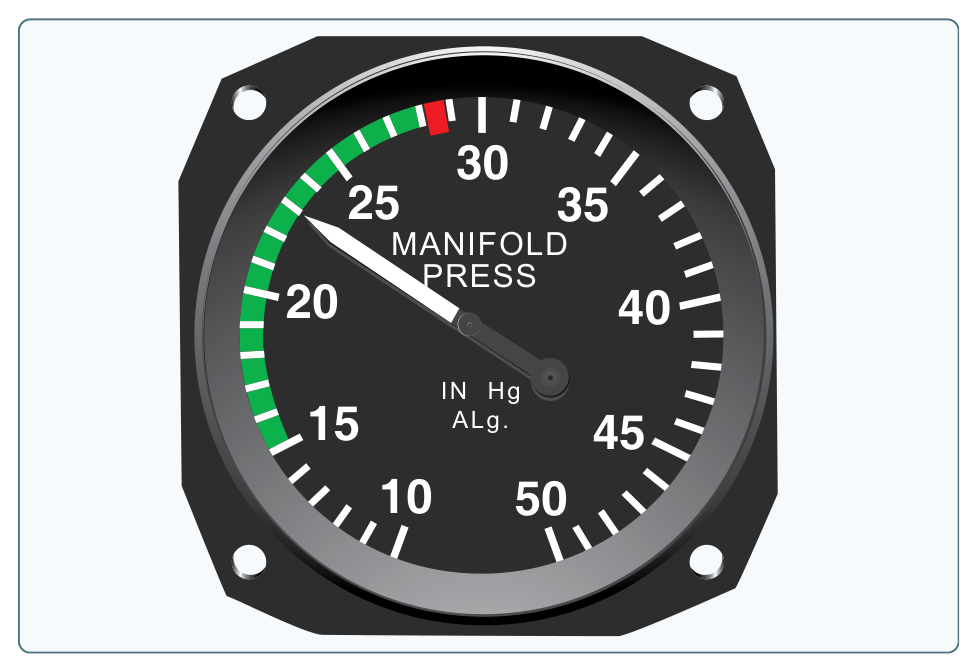
What the gauge reads, from engine off to cruise
| Condition | What manifold pressure shows |
|---|---|
| Engine stopped | Ambient air pressure: 29.92 “Hg at sea level on a standard day, or about 24.92 “Hg at a 5,000-foot airport on a standard day, since pressure drops about 1 “Hg per 1,000 feet |
| Engine running at idle | Below ambient (the PHAK’s idle example is 12 “Hg), because less throttle means less mixture flowing |
| Full throttle, normally aspirated | Never above the existing atmospheric pressure, so full-throttle manifold pressure falls as you climb |
| Turbocharged or supercharged | Can exceed ambient. An altitude turbocharger holds sea-level manifold pressure up to the airplane’s critical altitude, and some ground-boosted engines use as much as 45 “Hg for takeoff |
| Engine failure or power loss in flight | Rises toward the ambient pressure at that altitude |
| Carburetor ice | A drop in manifold pressure with no drop in RPM, because the governor holds RPM |
That last row matters: with a fixed-pitch propeller the first sign of carburetor ice is a loss of RPM, but with a constant-speed propeller you have to watch manifold pressure. Our engine guide covers carburetor heat.
Glance at the manifold pressure gauge before you start the engine. It should read close to the outside air pressure at your field elevation, so a reading far from that is worth a question to your mechanic.
The right order for power changes
The PHAK and the AFH give the same rule:
- Increasing power: increase RPM first, then manifold pressure.
- Decreasing power: decrease manifold pressure first, then RPM.
The reason is cylinder stress. For any RPM there is a manifold pressure that should not be exceeded, and if you reduce RPM before manifold pressure, manifold pressure automatically increases and can exceed the manufacturer’s limits. The AFH adds that excessive manifold pressure raises cylinder pressures and temperatures, and that high manifold pressure combined with low RPM can cause damaging detonation. Make every change smoothly and slowly to avoid overboosting or overspeeding.
Where the mixture fits
The handbooks’ sequence covers only the throttle and propeller. When the mixture must move too, the sequence becomes mixture, propeller, throttle to add power and throttle, propeller, mixture to reduce it, which keeps the RPM-before-manifold-pressure logic intact. The handbooks do not state this three-lever version as a rule, but the AFH uses the same order when it tells multiengine pilots to advance the “mixtures, propellers, and throttles” to identify a failed engine. How rich or lean to set the mixture comes from your POH; the PHAK notes, for example, that the mixture must be enriched during a descent from high altitude.
| Adding power | Reducing power |
|---|---|
| 1. Mixture as the POH directs | 1. Throttle back to the target manifold pressure |
| 2. Propeller forward to the target RPM | 2. Propeller back to the target RPM |
| 3. Throttle up to the target manifold pressure | 3. Mixture as the POH directs |
Oversquare: what it means and when it is fine
Pilots call a power setting oversquare when the manifold pressure in inches is a higher number than the RPM in hundreds, such as 24 inches at 2,100 RPM. You may hear a rule of thumb that you should never run oversquare. The FAA points you to the POH instead: the AFH says the RPM and manifold pressure combinations in the cruise power charts have been flight tested and approved by engineers for the airframe and engine, so a chart setting such as 2,100 RPM and 24 inches is approved for use. It adds that a takeoff from a low-elevation airport may be oversquare, which is normal in most cases; check the POH for limitations.
What the handbooks do warn against are the extremes: high manifold pressure at low RPM, which can cause detonation, and combinations of very low manifold pressure and high RPM, which the AFH says engine manufacturers strongly discourage.
What you'll need
The FAA handbooks that explain propellers and power management, and an oral exam guide for the questions examiners ask about them.


Run-up, takeoff and overspeed
- Start and run-up. Start with the propeller control at low pitch and high RPM. The AFH describes exercising the propeller during warm-up: with power set for about 1,600 RPM, move the propeller control to high pitch, low RPM, let RPM stabilize, then return to low pitch. That checks the system and circulates warm oil through the governor, and a propeller that is not exercised before takeoff may overspeed. Follow your POH run-up procedure.
- Momentary overspeed. Advancing the throttle quickly can briefly overspeed the propeller. The AFH says this is usually not serious if rated RPM is not exceeded by 10 percent for more than 3 seconds.
- Red line and green arc. The tachometer red line marks both the maximum allowable RPM and the RPM needed for rated horsepower. Below the green arc it is usually the windmilling propeller driving the engine, and prolonged operation there can harm the engine.
- Stuck at the low pitch stop. The PHAK cites FAA bulletin SAIB CE-10-21 (2010) on overspeeds after a pitch-change failure. Follow the POH emergency procedure; in some cases flying slower than best glide speed may allow continued flight, determined only at a safe altitude.
Frequently asked questions
What does a constant-speed propeller do?
It holds the RPM you select with the propeller control. A governor senses engine RPM and uses oil pressure to change the blade angle as airspeed and power change, so the engine and propeller run at an efficient RPM in takeoff, climb and cruise.
What does manifold pressure measure?
Manifold pressure is the absolute pressure of the fuel-air mixture inside the engine’s intake manifold, measured in inches of mercury. On an airplane with a constant-speed propeller, the throttle controls it, and it is your indication of power output, read together with RPM on the tachometer.
Why does the manifold pressure gauge read about 29 inches with the engine off?
With the engine stopped, the gauge shows the ambient air pressure: 29.92 inches of mercury at sea level on a standard day. At higher airports it reads less, because pressure drops about 1 inch per 1,000 feet, so about 24.92 inches at 5,000 feet on a standard day.
What is the correct order for power changes with a constant-speed propeller?
To increase power, increase RPM with the propeller control first, then manifold pressure with the throttle. To decrease power, reduce manifold pressure first, then RPM. That is the order in the PHAK and the Airplane Flying Handbook; set the mixture as your POH directs.
Is it bad to run oversquare?
Not if the setting is in your POH. The Airplane Flying Handbook says the RPM and manifold pressure combinations in the cruise power charts are approved for use, including settings such as 2,100 RPM and 24 inches. Avoid settings outside the charts, especially high manifold pressure at low RPM, which can cause detonation.
Does a constant-speed propeller make an airplane complex?
No, not on its own. A landplane is complex only with retractable landing gear, flaps and a controllable-pitch propeller. A fixed-gear airplane with a constant-speed propeller is not complex, though it may be high-performance if its engine is rated above 200 horsepower.