

Ground effect is the drop in induced drag, and the matching gain in lift at a given angle of attack, that an airplane gets when its wing is within about one wingspan of the ground or water. The surface weakens the wingtip vortices and downwash, and the closer the wing gets the stronger the effect: the FAA’s Pilot’s Handbook of Aeronautical Knowledge (PHAK) puts the induced drag reduction at 1.4 percent at a height of one span, 23.5 percent at one-quarter span and 47.6 percent at one-tenth span. It is why you float when you flare with extra speed, why an airplane can lift off before it is ready to climb, and why soft-field technique works.
Part of our How Airplanes Work guide, with companion guides on adverse yaw and the left-turning tendencies.
What ground effect is
A wing making lift has higher pressure below it than above it. At the wingtips that difference makes air spill up around the tip, which sets up the wingtip vortices and the downwash behind the wing. The PHAK explains that downwash points the relative wind downward, and because lift acts perpendicular to the relative wind, the lift vector tilts back. That rearward component is induced drag. It is largest at high angles of attack and low airspeeds, exactly where you are during takeoff and landing.
Close to the runway, the surface restricts the vertical part of that airflow. Upwash, downwash and the wingtip vortices all weaken, the lift vector stands up straighter, and induced drag falls. The wing then needs a lower angle of attack to make the same lift, and if you hold the same angle of attack it makes more lift. Because induced drag is most of the drag at low speed, the thrust required at low speed drops too.
It can feel as if the airplane is riding a cushion of air. The Airplane Flying Handbook (AFH) is blunt that the cushion is imaginary: the extra performance is borrowed from reduced induced drag, and you repay it as soon as you climb out of ground effect.
How close is close?
The PHAK glossary says ground effect exists within approximately one wingspan of the surface, and the AFH says it can normally be detected up to a height equal to one wingspan. It is not an on-off switch, though. A Cessna 172S has a wingspan of 36 feet 1 inch, so with heights measured to the wing, it is technically in ground effect below about 36 feet, but the effect only becomes large in the last 9 feet or so and is strongest in the last few feet: the flare, and the first moments after liftoff. It works over water as well as land.
Landing: why you float
The AFH defines floating as an airplane that will not settle to the runway because of excessive airspeed. Ground effect makes extra speed expensive. As you descend into it at a constant angle of attack, lift goes up and thrust required goes down, and the PHAK warns that with so little drag to slow you, any excess speed at the flare can turn into a considerable float. It also notes that you need to reduce power as you near the ground, or the airplane will tend to climb above your glidepath.
- Fix it on final. Fly the approach speed in your POH; the AFH says to use 1.3 VSO when the manufacturer gives none. (See how to land an airplane.)
- Keep flying it. Adjust pitch smoothly as the airplane slows and settles. The AFH lists forcing it onto the runway while it still wants to fly as a cause of porpoising.
- Expect a heavier nose. The AFH notes that ground effect reduces elevator effectiveness and increases the effort needed to raise the nose. Too little nose-up trim can mean a nose-low touchdown and a porpoise.
- Know your exit. The AFH’s rule: if you cannot land on the first third of the runway, or the airplane drifts sideways, go around.
Takeoff: airborne before you can climb
On the takeoff roll and just after liftoff you are deep in ground effect, so the airplane can fly at a lower indicated airspeed than it needs to climb. The instruments add to the illusion: the AFH says ground effect raises the pressure at the static source, so the airspeed indicator and altimeter read slightly low and the vertical speed indicator usually shows a descent. (See our pitot-static system guide.) Here is what changes as you climb out:
| What changes | In ground effect | Climbing out of it |
|---|---|---|
| Induced drag and thrust required | Lower | Higher |
| Angle of attack for the same lift | Lower | Higher |
| Pitch | Elevator less effective; more effort to raise the nose | Pitch-up tendency and less stability |
| Airspeed and altimeter | Read slightly low | Indicated airspeed increases |
The danger is lifting off below the recommended speed. Both handbooks warn that at high density altitude, high temperature or maximum weight, the airplane may become airborne in ground effect yet be unable to climb out of it, and may settle back onto the runway. The PHAK’s performance chapter adds that trying to climb out of ground effect before reaching climb speed can put you in the region of reversed command, where even full power may not let you climb or hold altitude, and the only way out is to lower the nose. Do not force the airplane off, since an excessive angle of attack can make it settle back or even stall; use the speeds in your POH, and check density altitude and takeoff performance before a marginal departure.
The same trap waits in a go-around close to the runway: the AFH warns that climbing prematurely may leave the airplane unable to climb, or even hold altitude, at full power.
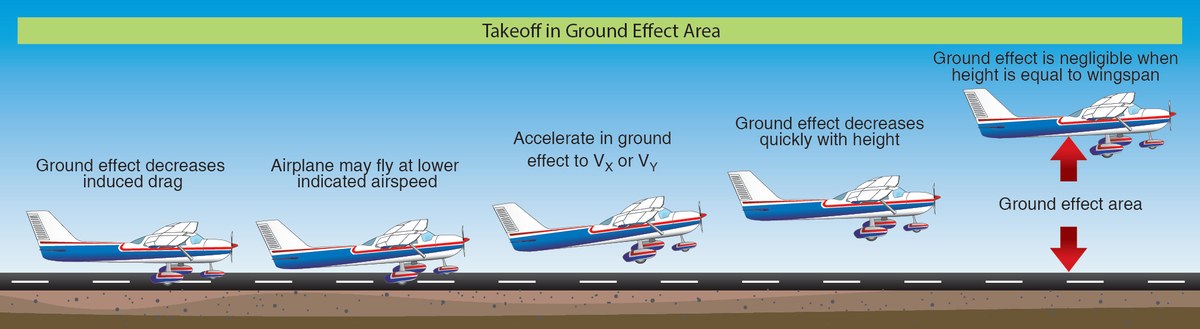
Using ground effect on purpose: soft fields
A soft-field takeoff turns ground effect into a tool. The AFH technique transfers the airplane’s weight from the wheels to the wings as early as possible with a nose-high attitude, using flaps if the manufacturer recommends them, so the airplane flies itself off the mud, grass or snow at an airspeed below a safe climb speed. Then:
- Gently lower the nose with the wheels just clear of the surface.
- Stay in ground effect and accelerate. The AFH warns that the airplane will tend to settle back if you leave ground effect early, even with full power, so remain in it until at least VX.
- Climb at VX until any obstacle is cleared, then at VY, retracting the gear and flaps, if equipped, once you are climbing at VY. Our V-speeds guide explains both speeds.
The private pilot ACS grades exactly this: lift off at the lowest possible airspeed and remain in ground effect while accelerating to VX or VY, as appropriate. The AFH’s common errors include climbing too high after liftoff, trying to climb out of ground effect before reaching climb speed, and failing to anticipate the pitch-up as the airplane leaves ground effect.
On a soft-field landing, ground effect helps again. Carrying a little power through the flare lets the airspeed dissipate slowly while you fly 1 to 2 feet off the surface, so the wings still carry much of the weight when the wheels touch. Approach too fast, though, and the AFH notes you will float in ground effect, which makes a smooth touchdown harder.
On a hot, high or heavy day, make your decisions before you take the runway. The AFH recommends identifying a point along the runway where the airplane should be airborne, and rejecting the takeoff if you reach it still on the ground. Pair that with the PHAK’s rule not to force the airplane off below the recommended takeoff speed, because an airplane that leaves the ground early may not be able to climb out of ground effect.
Ground effect on the checkride
Ground effect is a listed knowledge element in the private pilot ACS soft-field takeoff and climb task (PA.IV.C.K4), and skill element PA.IV.C.S9 has you use it. On the oral exam, be ready to explain what causes it (the surface restricts upwash, downwash and the wingtip vortices), what changes as you climb out of it (the table above), and why a heavy airplane on a hot day can lift off and then settle back.
What you'll need
The FAA handbooks this guide is built on, plus the flight computer for working out density altitude before a hot-day takeoff, from PilotMall.com.


Frequently asked questions
What is ground effect in simple terms?
It is the reduced drag and extra lift a wing gets when it flies close to the ground or water. The surface weakens the wingtip vortices and downwash, which cuts induced drag, so the airplane needs less power and a lower angle of attack to stay airborne.
How high does ground effect extend?
The FAA says it exists within approximately one wingspan of the surface, but it is weak at that height. The PHAK puts the induced drag reduction at 1.4 percent at one span, 23.5 percent at one-quarter span and 47.6 percent at one-tenth span.
Why does my airplane float when I land?
Floating comes from excess airspeed. Ground effect makes it worse because induced drag drops just as you flare, so the extra speed bleeds off slowly. Fly the published approach speed, and go around if you cannot touch down in the first third of the runway.
Why is ground effect dangerous on takeoff?
Reduced drag lets the airplane lift off below the speed it needs to climb. At high density altitude, high temperature or heavy weight it may fly in ground effect but be unable to climb out of it, and it can settle back onto the runway.
How do you use ground effect in a soft-field takeoff?
You lift off at the lowest possible airspeed, lower the nose to stay just above the surface, and accelerate in ground effect to VX or VY before you climb. The private pilot ACS grades exactly this in task PA.IV.C.